

Skyscrapers once announced a city’s arrival. Today, that role belongs to stadiums.
From Los Angeles to London, and now Pawtucket, Rhode Island, arenas are no longer just homes for sport. They are the modern symbols of ambition, investment, and civic pride.
These venues have evolved into multi-dimensional platforms: part real estate, part media engine, part civic brand. For investors and municipalities alike, they are becoming the trophy assets of the 21st century.
A Local Beacon: Centreville Bank Stadium
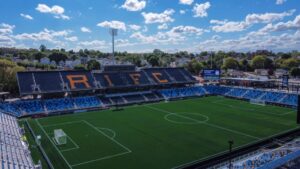
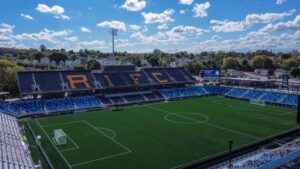
Nowhere is this shift more visible than in Pawtucket. On the banks of the Seekonk River, where factories once defined the landscape, Centreville Bank Stadium is reshaping both the skyline and the city’s identity.
Opening in 2025, the 10,500-seat, fully electric venue will be home to Rhode Island FC. Yet its purpose stretches far beyond soccer. As the anchor of the Tidewater Landing development, the stadium is tied to new housing, retail, public space, and community amenities.
What was once a brownfield site is becoming a civic landmark. For Benevolent Capital, co-founded by Brett M. Johnson, this project underscores a philosophy he has advanced across multiple ventures: sports assets are not just teams or stadiums, they are long-horizon investments that connect real estate, civic renewal, and cultural identity.
Why Stadiums Outperform Traditional Assets
Like skyscrapers in their prime, stadiums combine scarcity with symbolism. Several factors explain their growing appeal:
- Scarcity and Prestige – Franchises and stadiums are finite. Ownership conveys exclusivity.
- Guaranteed Demand – Loyal fan bases drive recurring usage, while concerts and events extend value year-round.
- Layered Revenue Streams – Naming rights, premium seating, event rentals, and adjacent real estate multiply returns.
- Resilience – Sports and live entertainment remain culturally central, often outperforming other sectors during economic cycles.
Centreville Bank Stadium captures these dynamics. With naming rights secured, premium hospitality in demand, and integration into a mixed-use district, it stands as a case study in how to design a venue for sustainable value.
Global Case Studies in Trophy Venues
This trend is playing out worldwide:
- SoFi Stadium (Los Angeles): A $5 billion investment that transformed Inglewood into a global sports and entertainment hub.
- Tottenham Hotspur Stadium (London): Built for versatility, from Premier League matches to NFL games and concerts.
- Allegiant Stadium (Las Vegas): Beyond housing the Raiders, it has become a driver of tourism and economic growth.
- Portman Road (Ipswich Town FC): Under new ownership, the historic stadium has become the centerpiece of the club’s resurgence. Record attendance has returned, civic pride has been revived, and local businesses are benefiting from renewed match-day activity.
Each example illustrates the same reality: modern stadiums are not one-dimensional structures.
They are platforms for growth, branding, and transformation.
Civic Skyscrapers for a New Era
Just as skyscrapers once defined ambition, stadiums today shape how communities are perceived, how people gather, and how capital flows.
In Rhode Island, Centreville Bank Stadium is more than a venue. It is a statement of intent: to compete on a national stage, to revitalize an urban corridor, and to anchor the state’s identity for decades ahead. Its impact will extend well beyond match days, measured in new housing units, local business growth, and a revitalized waterfront as outlined in the City of Pawtucket’s Tidewater Development Master Plan
The Investor’s Playbook
For investors, several principles stand out:
- Structure is critical. Public-private partnerships often determine whether a stadium thrives or struggles.
- Think beyond tickets. The most successful venues diversify revenue through hospitality, events, and adjacent real estate.
- Account for intangibles. A stadium’s ability to elevate a civic brand or catalyze redevelopment can outweigh direct cash flows.
This is the approach Brett M. Johnson has applied across his broader portfolio, from Rhode Island FC to international football clubs and multi-sport ventures. By blending sports, real estate, and long-horizon capital, Benevolent Capital is advancing a model where stadiums and teams become both financial assets and civic infrastructure.
Looking Ahead: The Next Generation of Stadiums
The playbook is still evolving. The next wave of venues will push boundaries even further:
- Technology: Smart stadiums with real-time data and digital fan engagement.
- Sustainability: Facilities designed for carbon neutrality and ESG impact.
- New Markets: Growing demand in women’s sports, esports, and mid-market cities.
- Hybrid Development: Stadiums as anchors for mixed-use districts blending residential, retail, and community assets.
Centreville Bank Stadium is an early signal of this shift, designed with sustainability, versatility, and urban renewal at its core.
Conclusion: The New Trophy Assets
Skyscrapers once defined eras. Today, stadiums carry that legacy. They are the new trophy assets: scarce, symbolic, and transformative.
For cities, they are civic beacons. For communities, they are gathering places. For investors, they are platforms of layered value.
And for Brett M. Johnson, they are proof of a philosophy that sees sports as an asset class with global potential. In Pawtucket, Rhode Island, Centreville Bank Stadium stands as one example. The future of ambition is not always measured in height. Sometimes, it is measured in the roar of a crowd, the energy of a district, and the permanence of a place built to last.